
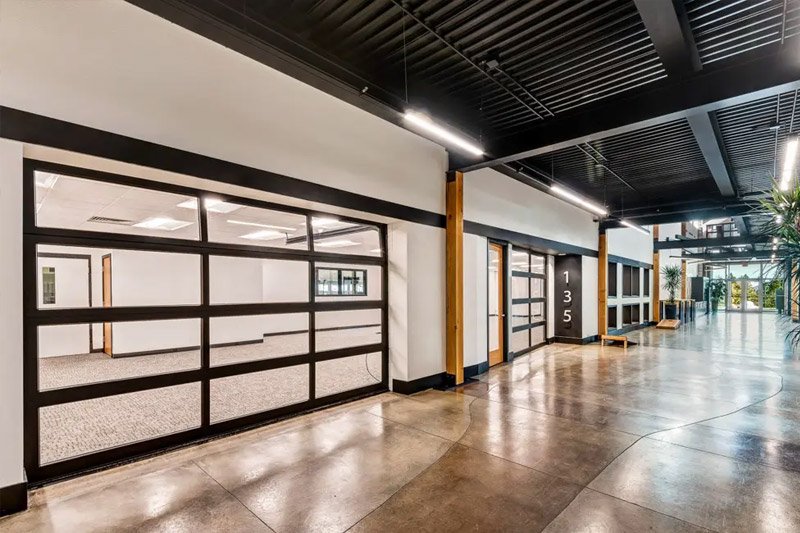
The way people work has changed a lot in the past decade. From open floor plans and collaborative common areas to flexible layouts that shift throughout the day, modern workspaces are designed to do more than just house desks and computers. They’re designed to inspire, to signal something about the people and businesses inside them, and to make the experience of showing up to work feel genuinely good.
That shift in how we think about workspaces has opened the door (literally) to some creative design solutions. And one of the most impactful has been the commercial garage door. What started as a feature borrowed from restaurants and breweries has found a natural home in offices, creative studios, coworking campuses, and multi-tenant commercial buildings across the country. In Central Oregon, we’ve seen it firsthand on some of Bend’s most interesting commercial renovation projects.
This post covers why commercial garage doors work so well in modern workspace environments, what to look for when choosing one, and how two Bend projects show what’s possible when the design is done right.
Key Takeaways
- Commercial garage doors are an increasingly popular choice for modern workspaces because they solve several design challenges at once: natural light, spatial flexibility, visual openness, and professional curb appeal.
- Full-view glass doors are the most common choice for office and workspace applications, but hardware finish, track placement, and integration with existing architecture all matter as much as the door itself.
- Hidden hardware and powder-coated finishes can make a garage door system disappear into the overall design—so the space feels intentional, not industrial.
- Large-scale commercial projects, like multi-tenant campus renovations, require careful coordination between door specs, structural elements, and the overall design vision. Experience with complex installations matters.
- Central Oregon Garage Door has completed workspace projects ranging from a 26-door campus renovation to a technically demanding multi-story commercial building installation—both in Bend.
Why Modern Workspaces and Commercial Garage Doors Are a Natural Fit
Think about what makes a workspace feel energizing rather than draining. Natural light is near the top of almost every list—research consistently shows that access to daylight improves focus, mood, and overall wellbeing at work. Open, uncluttered sightlines help too. So does a sense of connection—between people, between spaces, between the inside of a building and the world outside.
Commercial garage doors, particularly full-view glass designs, address all of those things in one architectural move. They flood interiors with natural light. They create visual openness across a floor plan. And when they’re open, they dissolve the boundary between interior and exterior in a way that makes even a modest space feel expansive.
For workspace designers and property developers, that’s a compelling combination. But the appeal goes beyond function. The right commercial garage door also makes a statement—about the kind of work that happens inside, the culture of the organization, and the quality of the space itself. For businesses that want their environment to communicate something to clients, partners, and prospective employees, that visual impression matters.
What to Prioritize When Choosing a Commercial Garage Door for a Workspace
The right door for a workspace does more than open and close. It shapes how light moves through the space, how the building presents itself to the outside world, and how flexible the floor plan can be day to day. Getting there requires thinking through a few key considerations upfront.
Full-View Glass for Light and Openness
For most workspace applications, full-view glass doors are the clear choice. Large glass panels set in aluminum frames let natural light flow freely through the space, maintain visual connection between rooms or zones, and give the interior a polished, contemporary feel.
Glass configurations can be tailored to the space: clear glass maximizes light transmission, frosted or tinted options offer privacy without sacrificing brightness, and low-E glass helps manage heat gain in sun-exposed orientations. If your workspace has significant south or west-facing exposure—common in Central Oregon’s high-desert climate—it’s worth discussing glass options early in the planning process.
Hardware That Disappears Into the Design
One of the things that separates a thoughtfully installed workspace garage door from a purely utilitarian one is the hardware. Tracks, brackets, springs, and mounting systems are all part of the picture. And in a workspace environment, bulky or mismatched hardware can undercut an otherwise beautiful installation.
Powder-coated tracks and hardware in a finish that matches or complements the surrounding architecture make a significant difference. So does strategic placement, like hiding springs above drop ceilings, routing hardware along existing structural elements, or choosing low-profile mounting options that keep the mechanical components as unobtrusive as possible.
The goal is a door system that feels like part of the building, not something bolted onto it.
Flexibility Between Open and Closed Configurations
One of the practical advantages of a commercial garage door in a workspace is the ability to reconfigure the space quickly and easily. Panels that connect interior offices to common areas can be opened for all-hands events or collaborative sessions and closed again for focused work. Exterior doors can be rolled up on warm days to open the space to fresh air, then closed when the weather turns.
That kind of flexibility is genuinely useful in a modern workspace—and it’s one of the reasons garage doors have found such a strong foothold in this environment. A fixed wall can only do one thing. A well-designed garage door does several.
Integration With Existing Architecture
Workspace installations, especially in renovation or adaptive reuse projects, often involve navigating existing structural elements: exposed beams, drop ceilings, unusual ceiling heights, or mixed materials. The door system needs to work with all of it, not just around it.
Custom track configurations, hardware adapted to specific structural conditions, and careful coordination between the door specs and the building’s existing architecture are all part of getting this right. It’s one of the areas where experience with complex commercial installations makes a real difference.
Two Bend Projects That Show What’s Possible
Both of these projects are in Bend, and both demonstrate something important: commercial garage doors in workspace environments aren’t a one-size-fits-all product. They’re a design solution that needs to be tailored to the space, the use case, and the vision for the building.
The Quad at Skyline Ridge
The Quad at Skyline Ridge is one of the most interesting commercial renovation projects Bend has seen in recent years. The former Bend Bulletin building—a landmark on the city’s Westside with roots going back to 1903—was transformed into a modern multi-tenant business campus with 20 rentable office units and a series of shared common spaces.
Central Oregon Garage Door was part of that transformation from the start. We installed a total of 26 CHI 3295 full-view doors throughout the building—across individual office units, common areas, and the seven operable doors that connect individual units to shared spaces. We also installed fixed panels designed to look like storefronts facing the open common areas, giving the interior the feel of a small, walkable commercial district.
The details mattered as much as the hardware. Our installation team hid springs above the existing drop ceilings to preserve the clean, modern aesthetic the renovation was going for. All tracks and hardware were powder-coated to blend seamlessly with the rest of the building’s finishes. The result is a space where the doors feel like part of the architecture—not an addition to it.
The full-view panels do exactly what they’re supposed to: light moves freely between spaces, the common areas feel open and connected, and the overall blend of contemporary and craftsman design that defines The Quad comes through in every detail.
→ View The Quad at Skyline Ridge project
Shevlin Crossing
The Shevlin Crossing project is a different kind of challenge, and a good example of what technically demanding workspace installations look like when they’re executed well.
Just off Bend’s Northwest Crossing neighborhood, this modern commercial building features heavy timber construction with glulam beams and posts—a striking aesthetic that required equally precise hardware integration. We installed PacDoor Apollo Full View Glass Doors throughout: black anodized frames inlaid with half-inch insulated clear glass, chosen specifically to balance the building’s dramatic timber structure with plenty of natural high-desert light.
The installation itself required a scissor lift to reach a 22-foot ceiling height—our technicians worked at elevation with all the necessary tools and materials to complete the job safely and correctly. Tracks and hardware were custom-made to fit the glulam beams and posts, ensuring everything integrated cleanly with the existing structure.
The finished doors give the building an airy, modern feel that complements the heavy timber aesthetic rather than competing with it. Functional, well-insulated, and visually cohesive—exactly what a high-end workspace environment calls for.
→ View the Shevlin Crossing project
A Better Door Makes for a Better Workspace
Commercial garage doors for workspaces aren’t just a design trend. They’re a practical, flexible, and visually powerful solution for businesses and property owners who want their space to work as hard as the people inside it.
Whether you’re renovating an existing building, developing a new commercial campus, or looking to upgrade a single office space, the right door—properly specified and carefully installed—can change how the space looks, how it feels, and how people experience it every day.
Central Oregon Garage Door has worked on commercial workspace projects of all sizes across Bend and the surrounding region. We understand what these installations require, and we bring the same care and precision to every project, whether it’s a single door or twenty-six.
Contact us for a free estimate and let’s talk about what the right door could do for your space.
Frequently Asked Questions: Commercial Garage Doors for Workspaces
What type of commercial garage door works best in an office or workspace setting?
Full-view glass doors in aluminum frames are the most popular choice for modern workspaces. They maximize natural light, create visual openness between spaces, and have a clean, professional look that fits well in contemporary office environments. Hardware finish and track placement are just as important as the door itself—details that blend with the architecture make a significant difference in the final result.
Can commercial garage doors be used as interior dividers between office spaces?
Yes, and it’s one of the most creative applications we see in modern workspace design. Operable interior doors allow spaces to open up for collaborative use and close again for focused work or private meetings—giving property managers and tenants a level of spatial flexibility that fixed walls simply can’t offer.
How do commercial garage doors affect energy efficiency in a workspace?
Insulated glass panels and quality perimeter weatherstripping help manage heat transfer, which matters in Central Oregon’s climate where summers are warm and winters are cold. For exterior-facing doors especially, discussing glass type and insulation rating during the planning process helps ensure the door performs well year-round—not just aesthetically, but energetically.
Do commercial garage doors work in buildings with unusual ceiling heights or structural elements?
Absolutely, but they require careful planning and experienced installation. Custom track configurations, hardware adapted to specific structural elements like timber beams or drop ceilings, and strategic placement of mechanical components are all part of making the system work in a non-standard environment. The Shevlin Crossing project is a good example: custom hardware fitted to glulam beams at a 22-foot ceiling height, completed safely with specialized equipment.
How do I get started on a commercial workspace garage door project?
Reach out to Central Oregon Garage Door for a free consultation. We’ll assess your space, talk through your design goals and functional requirements, and help you identify the right door, hardware, and installation approach for your project. No pressure—just an honest conversation about what will work best for your building and your budget.
