
When a garage door fails at a residential home, it’s an inconvenience. When one fails at a warehouse, a maintenance facility, or an equipment storage building, it can mean lost hours, disrupted operations, and a repair bill that nobody budgeted for.
That’s the reality for industrial businesses. The stakes are higher, the demands are greater, and a standard door just doesn’t cut it.
Commercial garage doors for industrial businesses need to do a lot more than open and close. They need to hold up under heavy daily use, keep the elements out, protect valuable equipment, and operate reliably year after year—without becoming a maintenance headache.
In this post, we’ll walk through the features that matter most for industrial applications, share two real projects we’ve completed here in the Pacific Northwest, and help you figure out what to look for when it’s time to invest in the right door for your facility.
Key Takeaways
- Industrial garage doors face demands that standard commercial doors aren’t built for—heavy cycle use, extreme weather, security requirements, and the need for near-zero downtime.
- The right door for your facility depends on your specific use case: what’s being stored, how often the door cycles, what climate conditions it faces, and how critical reliable operation is to your business.
- Insulation, high-cycle components, security features, and the right opener are all part of the equation—not just the door itself.
- Central Oregon Garage Door has completed industrial installations ranging from mountain ski facilities to high-use HOA complexes, with a process built around collaboration, precision, and long-term reliability.
Why Industrial Garage Doors Are a Different Animal
Not all commercial garage doors are created equal. A door designed for a retail storefront and a door designed for a heavy equipment facility might look similar on the outside. But under the hood, they’re built for completely different lives.
Industrial environments put doors through their paces in ways that most manufacturers account for—but only if you’re choosing the right product for the job. Higher cycle counts. Heavier loads. Wider and taller openings. Exposure to extreme temperatures, dust, debris, and sometimes full-on mountain weather.
One thing industrial business owners miss is that buying the wrong door for an industrial application doesn’t just mean replacing it sooner. It means dealing with unexpected breakdowns, security vulnerabilities, and energy inefficiency along the way. Getting it right from the start saves money, time, and a lot of headaches down the road.
The Four Things Industrial Buyers Should Prioritize
1. High-Cycle Durability
Every time a garage door opens and closes, that’s one cycle. For a typical residential door, that might mean 3–5 cycles a day. For an industrial facility, it could mean dozens—or more.
Standard springs and hardware aren’t designed for that kind of volume. High-cycle springs, rated for 25,000 cycles or more, are a must for high-frequency applications. The same logic applies to rollers, hinges, and cables—industrial-grade components cost more upfront, but they dramatically extend the life of your system and reduce the frequency of service calls.
When we’re speccing out a door for an industrial client, cycle count is one of the first questions we ask. It shapes nearly every component decision that follows.
2. Insulation That Actually Performs
Heat loss through a poorly insulated garage door is a real problem for industrial facilities—especially in Central Oregon, where winter temperatures can drop well below freezing. An uninsulated or under-insulated door forces your heating system to work harder, drives up energy costs, and can affect the storage conditions of equipment, products, or materials that are sensitive to temperature swings.
Look for doors with meaningful R-values (R-8 or higher for cold-climate applications) and quality weatherstripping around the perimeter. Insulated rails and stiles matter too—not just the door panels themselves.
For facilities that store sensitive equipment or operate year-round in harsh climates, this isn’t a nice-to-have. It’s a requirement.
3. Security You Can Count On
Warehouses, equipment storage buildings, and industrial facilities often house tools, materials, and machinery worth hundreds of thousands of dollars. A garage door is a large point of entry—and it should be treated like one.
Commercial-grade lock options—including interior slide bolts, keyed locks, and integrated locking systems—add meaningful protection beyond just pulling the door closed. Pairing a secure door with a reliable, code-compliant operator adds another layer.
The peace of mind that comes with knowing your facility is properly secured overnight or over a weekend is hard to put a price on. But it starts with choosing a door and lock system built for the job.
4. Reliability Under Pressure
In an industrial setting, a door that goes down unexpectedly isn’t just inconvenient—it can bring operations to a standstill. That’s why reliability isn’t just about the door; it’s about the whole system working together: the door itself, the opener, the tracks, the hardware, and the ongoing maintenance that keeps everything running.
Choosing quality components from proven manufacturers, pairing them with the right operator for the load, and committing to a regular maintenance schedule are the best ways to minimize unplanned downtime. We’ll come back to that last point, but it’s worth flagging early: even the best door needs professional attention on a regular basis.
Two Industrial Projects That Show What’s Possible
We’ve worked on industrial door projects across a wide range of facilities and conditions. Two stand out as good examples of what the right door, installed well, can do for a demanding operation.
Teacup Nordic, Mt. Hood
This one is a good example of what industrial garage door work can look like when the conditions are genuinely demanding.
Teacup Nordic, a cross-country skiing facility on Mt. Hood, needed a secure, well-insulated home for a brand-new PistenBully snow groomer—the equipment responsible for maintaining 15 miles of ski terrain. Our client, I&E Construction, had a tight window: the doors needed to be installed before the new equipment arrived and before winter weather moved in.
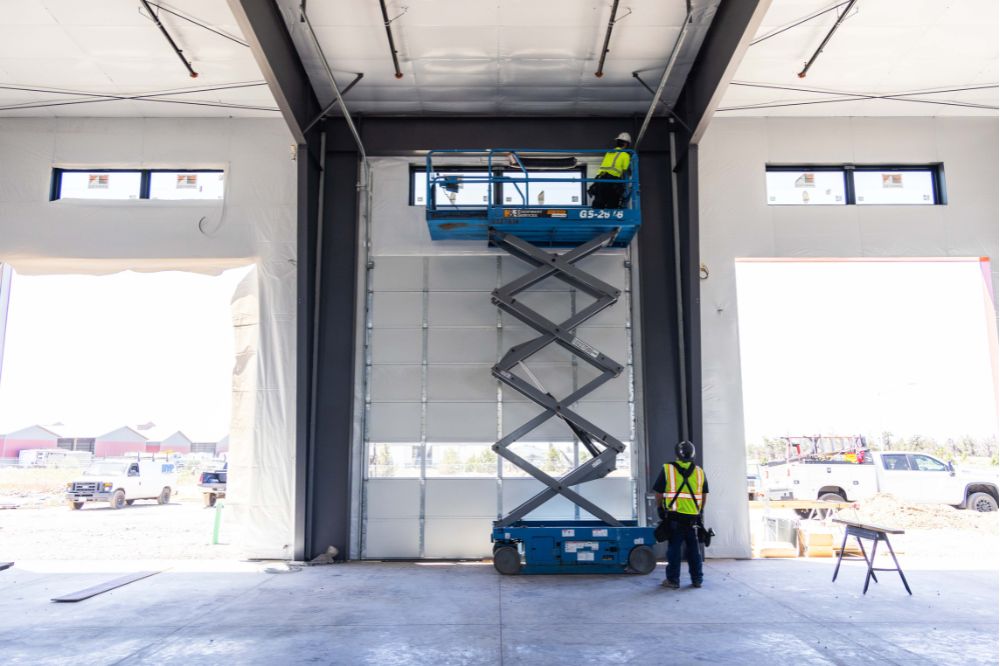
A three-person installation team from Central Oregon Garage Door completed the full two-door installation in a single day.
The doors we installed were 24-gauge metal CHI commercial doors with R-8 vinyl-backed insulation and PVC head and jamb weatherstripping. This choice was made specifically for their thermal performance in an extreme mountain climate. A two-inch clip into a wood track with a 15-inch radius solved the overhead clearance challenge, ensuring the PistenBully could move in and out without issue. A manual inside lock keeps the equipment secure between uses.
Fast turnaround, precise installation, right door for the environment. That’s what industrial work looks like.
→ View the Teacup Nordic project
Sunriver HOA Facility
When Wolf Construction & Development partnered with the Sunriver Homeowners Association on a new commercial facility, the priority was clear: doors that could handle frequent daily use without sacrificing insulation or reliability—and that would look good doing it.
We spec’d a Wayne Dalton TS-150 for this project—an R-10 insulated, two-inch-thick steel door with strong thermal efficiency and structural integrity built for exactly this kind of high-use environment. Aluminum full-view panels with clear glass add natural light and a clean, professional appearance. Side-mounted Genie 6170 jackshaft motors handle operation smoothly, even under heavy daily cycling.
The client’s feedback said it well: the doors do the functional job they were built for, while also enhancing the overall look of the building. Durability and aesthetics don’t have to be a trade-off—and this project is proof.
→ View the Sunriver HOA project
Don’t Overlook the Opener
A great industrial door paired with an underpowered or mismatched opener is like putting the wrong engine in the right car. It won’t perform the way it should—and it’ll wear out faster because of it.
For industrial applications, we typically look at commercial-grade operators from LiftMaster, which offer the cycle ratings, motor strength, and reliability that high-use environments demand. For especially heavy-duty applications—oversized doors, unusually heavy door weights, or specialized access requirements—there are custom solutions available as well.
The opener conversation is part of every commercial project we take on. It’s not an afterthought.
Finding the Right Industrial Garage Door Is Worth the Effort
Commercial garage doors for industrial businesses aren’t a commodity purchase. The door you choose, the components it’s built with, and the quality of the installation all have a direct impact on your operations, your energy costs, your security, and your long-term maintenance budget.
At Central Oregon Garage Door, we’ve been doing this work for over 20 years. From mountain ski facilities to high-use HOA complexes to warehouses and beyond, we understand what industrial applications demand—and we’ll help you find a solution that holds up.
Ready to talk through your project? Contact us for a free estimate and let’s figure out the right door for your facility.
Frequently Asked Questions: Commercial Garage Doors for Industrial Businesses
What makes a garage door “industrial grade”?
Industrial-grade commercial garage doors are built for high-cycle use, heavier loads, and more demanding environments than standard commercial doors. They typically feature high-cycle springs, thicker steel, higher insulation ratings, heavy-duty hardware, and commercial-grade operators—all designed to perform reliably under daily heavy use.
How do I know what R-value I need for my industrial facility?
It depends on your climate and what you’re storing. For Central Oregon facilities exposed to cold winters, R-8 to R-10 is a solid baseline. If you’re storing temperature-sensitive equipment or materials, or if the space is climate-controlled, prioritize higher insulation ratings and pay attention to weatherstripping quality as well—panels alone don’t tell the whole story.
How often do industrial garage doors need to be serviced?
More often than residential doors, and usually more often than standard commercial doors too. For high-cycle industrial applications, quarterly service is often appropriate. A professional garage door company can help you build a maintenance schedule based on your specific usage patterns. Here’s a deeper look at how service frequency works.
What security features should I look for in an industrial garage door?
At minimum, look for interior slide bolts or keyed lock options. For facilities storing high-value equipment, consider doors with integrated locking systems and pair them with a commercial-grade operator that includes rolling code technology. A well-secured door is your first line of defense.
Can you install industrial garage doors on tight timelines?
Yes—and we’ve done it. The Teacup Nordic project is a good example: a full two-door installation completed in a single day to meet a hard deadline before new equipment arrived. Tight timelines are part of commercial and industrial work, and we plan accordingly.
